


On this page
Introducing Travelling Well Together - Sustaining Ministry
This autumn, parish communities across Chelmsford Diocese are invited to pause, pray, and talk together about how we can be an enduring missional presence in Essex and East London in the times and context in which God has placed us.
Click the boxes below to find out more.
-
Travelling Well Together
In 2023, after a period of listening and discernment that began when Bishop Guli became Bishop of Chelmsford, the Bishop’s Leadership Team began to articulate a new direction of travel for our diocese under the title of Travelling Well Together:
- Our purpose is to love God and to love our neighbour, to worship faithfully and empowered by the Holy Spirit, witness to the love of God revealed in Jesus Christ as we serve the extraordinarily diverse array of local communities in Essex and East London.
- Our approach is to enable and empower parishes and worshipping communities to discern how they are to be God’s people in their own very different local contexts as part of one diocesan family.
- Underpinning our approach is an invitation to a way of being articulated by shared diocesan values which might shape how we travel well together, support each other and provide mutual accountability.
-
How Travelling Well Together has begun to shape our diocesan life
Since 2023, Travelling Well Together has begun to shape our diocesan life, in particular by helping us to address areas of significant challenge and change. Examples include the Parish Share Consultation, which took place at the same time as Travelling Well Together was being developed, our Church Buildings Support Conversation, a new approach to ministerial wellbeing, conversations about the Prayers of Love and Faith and the development of missional plans in each Episcopal Area to be supported by the national Church’s Diocesan Investment Programme. You can read more about these examples on page 10 of our Travelling Well Together booklet.
In each case Travelling Well Together has helped us to:
- Move beyond a top down approach and towards prayerful, local discernment and participative change; praying, listening, and working together with those who are most involved and affected locally
- Recognise that how we face challenges together is as important as the outcome. Many challenges remain, but by focusing on how we Travel Well Together, we can better discern what God is calling us towards.
- Be faithful, creative, courageous and open to the unexpected and surprising.
-
Sustaining Ministry
Travelling Well Together - Sustaining Ministry is a wide-ranging conversation, addressing the challenges of smaller congregations, maintaining church buildings, reduced financial income, fewer ordinands, clergy wellbeing as well as the changed nature of the communities we serve and the significant missional opportunities that are present in Essex and East London. You can read more about some of these challenges and opportunities in the Sustaining Ministry paper that was presented to the March 2025 meeting of Diocesan Synod.
In an approach developed by a team of clergy and lay people from across the Diocese, the Sustaining Ministry conversationis being shaped by Travelling Well Together. There will be:
- A focus on prayer, local discernment and participative change
- Encouragement to be open to what God is calling us towards with the resources he has provided – to think creatively and courageously and to ask brave questions about difficult situations where anxiety may be present.
- An emphasis on using existing structures for conversation, such as deaneries, rather than creating new structures
- Efforts to reach beyond those who normally take part in similar conversations, to involve a broader representation of people from our church communities
- Data and information to equip those who participate in conversations
- Time for participants to explore issues with the necessary depth and creativity and prayerfully discern together

Introducing 100 Days of Listening - 6 September to 15 December 2026
On 6 September, we will begin a period of 100 Days of Listening. This follows a period of 100 Days of Prayer that took place earlier this year.
The 100 Days of Listening is an invitation to pause, pray, and talk together. Across the Diocese of Chelmsford people are faithfully serving God in their parish communities. There is much to give thanks for, but at the same time many parish communities are facing real pressures.
We’ve identified four topics that impact many of our parish communities across the diocese. The four topics are:
- Vocations
- Wellbeing
- Buildings
- Finances
These four topics were presented to Diocesan Synod in March 2025.
However, the 100 Days of Listening is not limited to those four topics. In your deanery, archdeaconry, or episcopal area, one or two of the topics may be more important than the others and you will want to give more time to those. Your episcopal area team might suggest some topic questions to focus on. There will also be topics you want to talk about that are specific to your parish or deanery.
You will see that in the 100 Days of Listening Discussion Resource (below) there is a fifth topic called “What’s missing?” to identify and talk about the challenges that matter where you are.
We want to listen carefully to one another’s experiences, hopes and concerns, and to discern together how God is leading us as we seek to sustain ministry and join in God’s mission across the many parish communities of East London and Essex that make up the Diocese of Chelmsford.
Taking Part in 100 Days of Listening - Discussion Resource for Church Communities
So how can we participate in the 100 Days of Listening? A Discussion Resource has been written to support church communities as they take part in the 100 Days of Listening. The document introduces the key topics in more detail and includes suggestions and ideas to support conversations in church communities. Additional resources are included in the 'Further resources' section below.
Download the Discussion Resource
Frequently Asked Questions about the 100 Days of Listening
-
What is 100 Days of Listening?
Sustaining Ministry 100 Days of Listening is an invitation to pause, pray, and talk together following on from our 100 Days of Prayer. It is a time to listen carefully to the lived experience, hopes, concerns, and wisdom of people across the Diocese of Chelmsford, so that together we may discern how God is calling us to sustain ministry and mission into the future.
Prayer involves listening, and listening involves prayer. The separation of the 100 Days of Prayer and the 100 Days of Listening is not intended to divide the two, but to help us give time and attention to both. We listen to God in prayer and through scripture, and as we hear one another speak.
-
Why are we listening now?
Change is already part of our lives when we follow Jesus as disciples. The world around us is changing, our communities are changing, and those changes impact us. In March 2025 we shared with our Diocesan Synod four topics that impact many of our parish communities. The four topics are vocations, wellbeing, buildings, and finances.
However, the 100 Days of Listening is not limited to those four topics. In your deanery, archdeaconry, or episcopal area, one or two of the topics may be more important than the others and you will want to give more time to those. Your episcopal area team might suggest some topic questions to focus on. There will also be topics you want to talk about that are specific to your parish or deanery.
You will see that in the 100 Days of Listening Discussion Document there is a fifth topic called “What’s missing?” to identify and talk about the challenges that matter where you are.
-
What are some of the key questions?
There are some overall questions that shape our listening process as a whole; they sit alongside the suggested “talk together topic” questions in each of the four topics of vocations, wellbeing, buildings and finance.
- What sort of church is God calling us to be in this place and at this time?
- How can ministry and mission be sustained in our parish, worshipping community, deanery and diocese?
- How can we encourage and nurture vocations, both lay and ordained, locally?
- How can clergy, licensed ministers, lay leaders and volunteers be supported to flourish?
- How can we care wisely for our church buildings, governance and finances in ways that serve mission?
- What might need to change if we are to remain faithful, hopeful and outward-looking?
- What are we hearing from God, from one another, and from the communities we serve?
These questions will be encountered differently in different places. With each topic area we’ve included some suggested questions for “talk together topics”. You can use these questions, or you can create your own. The important thing is to take time to pause, pray, and talk together. There are no perfect answers.
-
Who are we listening to?
We are listening to one another across the whole diocesan family: in PCCs, small groups, youth groups, Deanery Synods and Chapters, Bishops’ Council, Diocesan Synod, and other places where people gather for prayer, reflection and conversation. We especially want to hear from people in different parish and worshipping communities, because the challenges and opportunities we face are experienced differently in each place.
Listening well means making space for a range of voices, including those who may not usually speak in formal church meetings. It means listening with curiosity rather than defensiveness, with prayer rather than anxiety, and with the expectation that God may speak through the experience and wisdom of others.
-
How should conversations happen?
The encouragement is to frame every conversation in prayer. We are reminded in scripture that our prayers rise before God. As we gather, Christ is with us and the Holy Spirit is present. The 100 Days of Prayer resources will continue to be available through the Sustaining Ministry webpages to help you talk and listen together.
Good listening is not the same as debate. It is not about winning an argument, defending a position or rushing to a solution. It is about creating space for people to speak honestly, to be heard respectfully, and to notice together what themes may be emerging. Conversations may happen in different ways in different contexts, but they should be shaped by prayer, humility, kindness and hope.
-
How will what we hear be shared?
Towards the end of the 100 Days of Listening, an online survey will be shared to help collect what people have heard as they have prayed, talked and listened to one another. A survey tool is not perfect, but it will help draw together voices from across our large and diverse diocese.
What is shared through the survey will help identify themes, questions, hopes and concerns arising from local contexts. The aim is to listen carefully before making decisions, and to allow what has been heard to shape the next stage of shared discernment.
-
Is there already a diocesan plan?
No. This is not about imposing a single model or solution. The Diocese of Chelmsford is made up of diverse and complex communities. There is no one size fits all answer to the challenges we face. Sustaining Ministry is about prayerful readiness, shared listening and local discernment as we prepare to meet the challenges ahead and join in God’s mission to the communities we serve.
-
What are we being asked to do?
- Continue to pray for your parish, worshipping community, deanery and diocese.
- Gather people together to talk and listen in ways that fit your local context.
- Use the questions to reflect honestly on vocations, wellbeing, buildings, finances and mission.
- Make space for people whose voices may not always be heard.
- Notice what gives life, what creates pressure, what needs courage, and what gives hope.
- Share what you have heard through the survey when it becomes available.
-
What happens next?
After the 100 Days of Listening, the hope is that prayerful conversation will continue in parish and worshipping communities across the diocese. Sustaining Ministry – Travelling Well Together is about how we seek to be an enduring missional presence in the communities to which God has called us.
In Summer 2027, a report of what has been heard through the online survey will be presented to Diocesan Synod. This will enable Synod to pray and discuss the themes that have emerged, as we continue to discern our future together.
Further resources to support local conversations
-
Discussion resource
The Discussion Resource has been written to support church communities as they take part in the 100 Days of Listening. The document introduces key themes as well as suggestions and ideas to support conversations in your church communities.
-
Guide to reflective listening
Taking time to listen to one another when we are talking about difficult subjects can be challenging. It is difficult to listen when our heart is stirred, and we want to tell other people what we think because we are worried we won’t be listened to or our view won’t be heard.
Joe Holland & Peter Henriot and John Stott offer two practical frameworks for discussing change, challenge and discernment together. The two models outlined in this resource are not only designed to help us focus on one challenging discussion item at a time so that we can listen to one another, but importantly at the heart of each model is prayer, scripture, and reflection, to help us listen to God as we listen to one another.

-
Prayer resources
These prayer resources were written and prepared for our 100 Days of Prayer and can continue to be used throughout the 100 Days of Listening
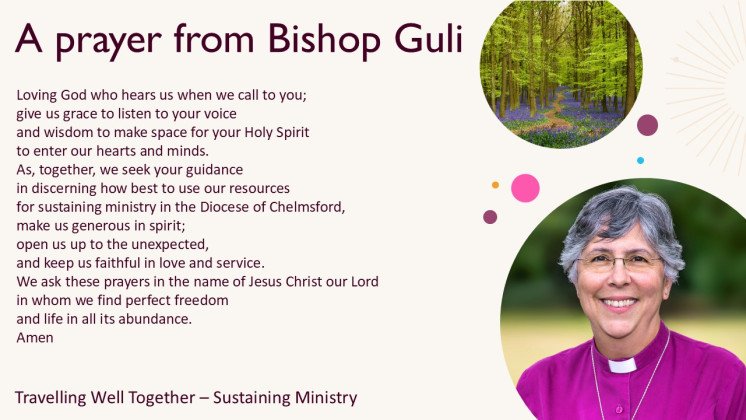
A prayer from Bishop Guli
A Weekly Prayer Calendar
A weekly prayer calendar with prayers associated written for the key Travelling Well Together - Sustaining Ministry themes
A Prayer Course
This course was offered as a resource for the 100 Days of Prayer. Its presiding scripture is the Emmaus journey (Luke 24.13-35), a road that is both a road of uncertainty and loss (those travelling it are mourning Jesus’s death) and a resurrection road (he is walking alongside them all the time). So, it is both a wilderness road and a resurrection journey.
Bible Study Sessions
A series of six bible study sessions written for the 100 Days of Prayer
Download the Bible Study Sessions
-
Video Reflections
The 100 Days of Prayer Course was accompanied by a series of six reflections on our shared diocesan values, articulated in Travelling Well Together.
Reflection 1 - Awareness of Grace
With the Rev'd Canon Janet Nicholls, Diocesan Rural Adviser and Agricultural Chaplain
Download a transcript of this reflection here.
Reflection 2 - Open to the unexpected and surprising
With the Rev'd Dan Scott, Vicar of Christchurch Three Mills, and Estates Churches Mission Adviser for the Barking Area
Download a transcript of this reflection here.
Reflection 3 - Valuing the marginal; focusing outward
The Rev'd Funmilayo Vaughan, Rector of St Mary Magdalene, Frinton
Download a transcript of this reflection here.
Reflection 4 - Kindness, mutual respect, gentleness, humility
The Rev'd Dr Jonathan Pritchard, Rector of Witham and Villages
Download a transcript of this reflection here.
Reflection 5 - Awareness of grace; kindness
The Very Rev'd Dr Jessica Martin, Dean of Chelmsford
Download a transcript of this reflection here.
Reflection 6 - Creative, courageous; open to the unexpected and surprising
Canon Caroline Harding, Lay Ministry Adviser and Warden of Readers
Download a transcript of this reflection here.


